Pedigree notes
Author: Jane Nemecek, pictures: Sporthorse-Data
A pedigree analyst comes across a lot of fascinating stuff. That's what I like the most about the job, actually: discovering forgotten great runners, historical families present in current horses... Great pieces of the thoroughbred history. For many years now, I'm used to collect them and write them down in a notebook. I always thought it would be really nice to share them - so this particular section of the website is a kind of dream come true.
One thing I regret, though... This "notebook" allows me to share only scattered pieces of history. Most stories you can read here are still connected with present racing, believe it or not. I really dream of doing complete books on thoroughbred history and bloodlines some day.
Mary Tudor (Pharos - Anna Bolena), 1931
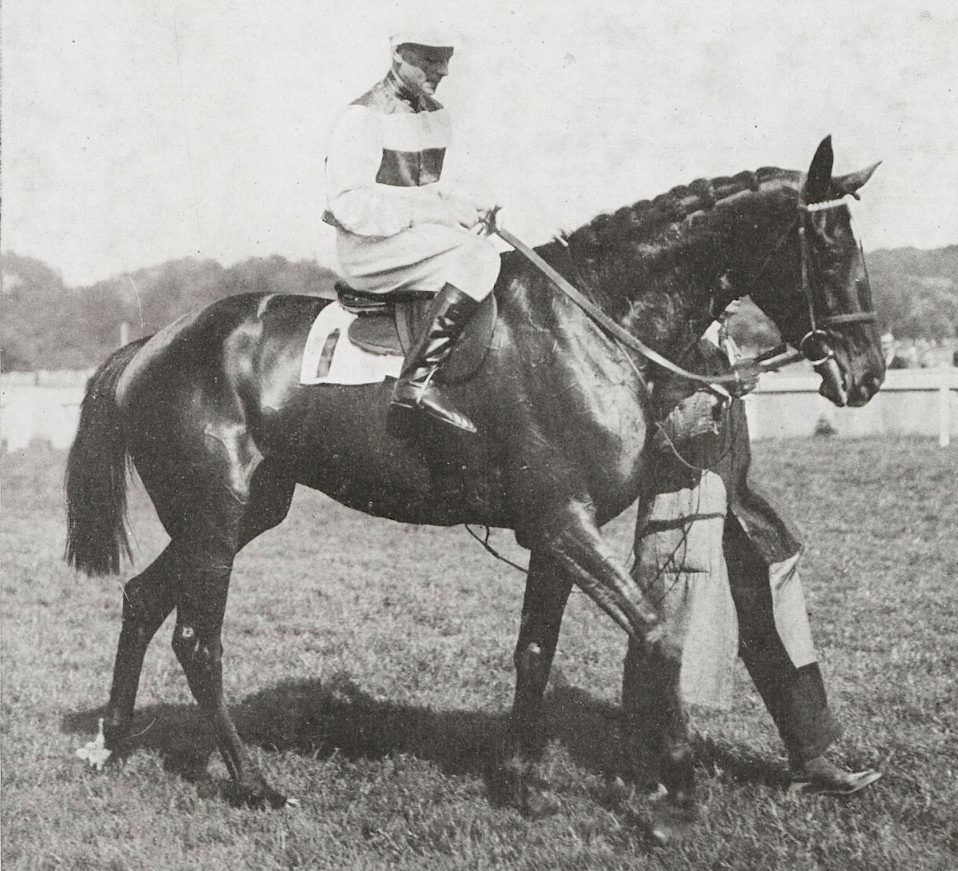
Owen Tudor (born 1938, by Hyperion) is one of my favorite stallions of all times. His race record was dubious, and his stud career was not all that successful; but you have to give him one thing: his influence, as it shaped up during the decades, was just magnificent. Not only through his own enormous branch of a Hyperion sireline; he was also the sire of Abernant, the damsire of German foundation mare Love In, or the influence in Cipayo, Temperence Hill, Gulch - not to mention all major stallions with Tudor Minstrel in their pedigrees.
And with a stallion like this, it's always great to see his dam.
Mary Tudor was not just some mare. She was a great two-year-old, placed in four major stakes - most notably third in the Grand Criterium behind the great Brantome. So was a filly named Macestar in the Prix Morny, and Mary Tudor defeated her right in the spring of their three-year-old season, collecting an impressive victory in the Prix Chloe. And she was no less dominant in the Poule d'Essai des Pouliches, as you can see in the attached picture.
Mary Tudor crowned her three-year-old campaign with another prestigious victory in the Prix Vermeille, but she also suffered some summer defeats. After leading in the stretch of the Prix de Diane, she was overtaken by Adargatis to lose barely by two or three lengths. Only 10 days later, she was poised for another defeat, a minor stakes race at Le Tremblay. And the same track saw her July defeat in the Prix Minerve, by a length from a very good 10-furlong filly Anatolie. The bitter postscript of the story was that Adargatis, whose only major victory was the Prix de Diane - where she was a better horse than Mary Tudor for maybe one or two furlongs, no less - was crowned the champion three-year-old filly.
In a certain way, their stud careers remained parallel as well. Owen Tudor won war substitutes of the Epsom Derby and the Ascot Gold Cup; Adargatis, a half-sister to La Troienne, became another celebrated dam with the Prix de l'Arc de Triomphe winner and champion colt Ardan. Both him and his full brother Pardal turned out to be successors of Pharis and the founders of their separated tail-male lineages. Owen Tudor would certainly outrank them both, but when it comes to mare families, Adargatis got luckier than Mary Tudor with horses like Spend a Buck, Hula Angel, or Vindication - and most of all, present survival. Mary Tudor's family remained a very narrow one and as far as an online researcher can trace, the family was present marginally in the United States and Venezuela. It probably succumbed in the last decades of the 20th century.
Not that it takes any credit from Mary Tudor, otherwise a dam of at least six winners and a member of an exclusive club of the Derby winners' dams. But the reason she was given priority in my "blog" is somewhere else: she must have been the great filly on her own.
Monsieur le Maréchal
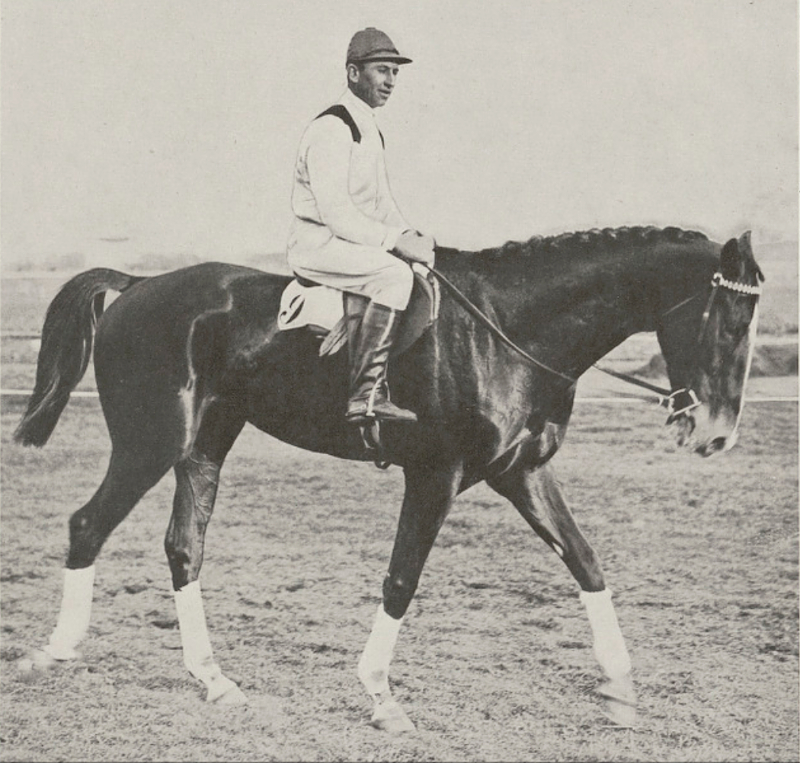
Did you have some favorite racing novels when you were young? I certainly did, and one of mine was called "A boy and a horse." A Facebook fan reminded the old book recently, and to my great surprise, many people know the book and love it. Among several storylines, there's an old groom recounting his early days as a jockey, and he tells a story of how his horse fell near the finish line when comfortably winning the Prix Gladiateur in the early 1930s. While the whole book is a piece of fiction, this really happened - to a horse named Monsieur le Maréchal. Having seen the pictures before, I decided to collect them and write the story for Czech racing fans - and now that it's complete, it would be a shame not to share it here.
It's worth saying that similar stories of bad luck are usually well-known tales of horse-racing. Be it Devon Loch's tragedy in the 1956 Grand National, or things like Dayjur's jump over the shadow in the 1990 Breeders' Cup Sprint. Monsieur le Maréchal's story is no less touching. Just probably happened too far in the history to be public knowledge.
Bred by Mr. de Mole in 1926, Monsieur le Maréchal was a big, rangy, late-maturing horse. It was not until the late October of his four-year-old season that he was ready for a big effort, winning the Prix Gladiateur by about two lengths. Prix Gladiateur is now an ordinary Gr.3 race run over almost two miles, but back then, it was a grueling test over almost four miles - a real test of champions, you may say, as it was won by horses like Gladiateur, Trocadéro, Omnium II or Sea Sick. Even the great Ksar contested the race, and on a horrible October day, he finished close second to his old rival Flechois. However, as for the 1930 edition - an average victory of a largely unknown horse was not a big public concern.
It did, though, set the fate of Monsieur le Maréchal. Instead of some winter rest, the big horse was sent to South France for winter hurdle races. And he did great: running second to "wondrous" Ginger Ale in the Grand Prix de la Ville de Nice, and easily winning the Grand Steeple-Chase de Cannes. Back at Longchamp, he easily won the Prix Rainbow over more than 3 miles; and once more tested over jumps, he came home a close third against the best hurdlers in the Grande Course de Haies d'Auteuil. Commentators noticed that with a faster pace, he would have had a better chance at winning against former top sprinter Baoulé.
So far, Monsieur le Maréchal was one of the best young chasers in the country, but his story took a major turn in August when the five-year-old contested the Prix Jumilhac. The race doesn't exist anymore, and the same goes for the Le Tremblay racetrack, which harbored French classic races during the World War II. But once again, in 1931, Prix Jumilhac was abt 2 1/2 miles long test worth 100,000 francs - for example, twice as much as the Prix de la Salamandre at Longchamp. And Monsieur le Maréchal showed great form at Le Tremblay, barely cantering to an easy victory.
By this time, it was known that he was going to defend his Prix Gladiateur victory. But the atmosphere before the race was completely different from the previous season: Monsieur le Maréchal was coming into the race as the exciting top-class stayer in his peak form. Few people, if any, expected him to lose.
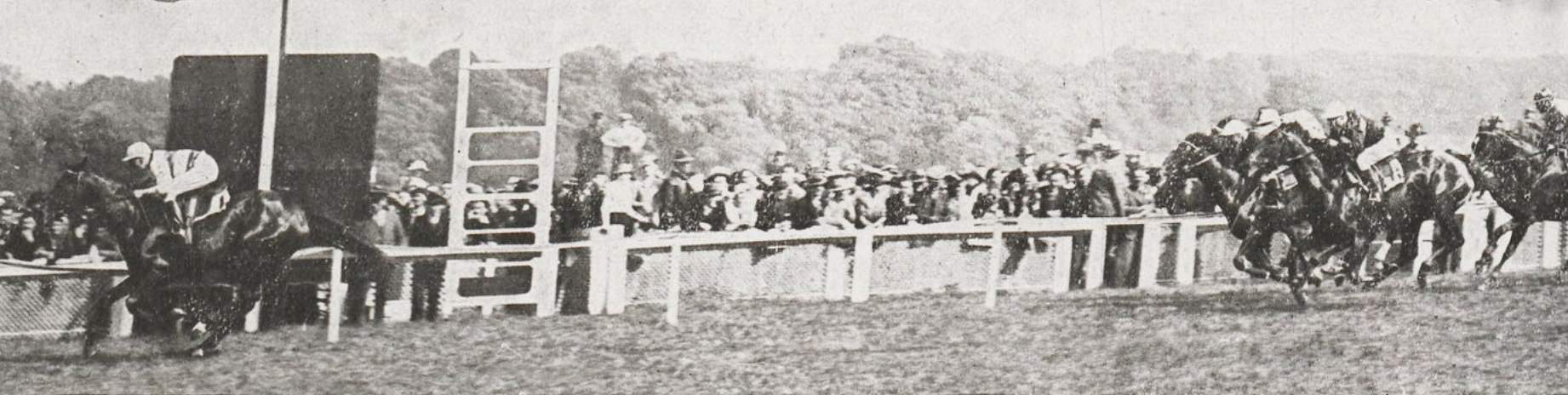
And Monsieur le Maréchal didn't disappoint. He was nearing the finish line all alone, maybe 15 lengths ahead, maybe 18... in a sensational time of 7:40 for 6,200 meters. Then, all of a sudden - just a few strides from the finish line, the horse fell, shooting Joe Marshall to the grass.
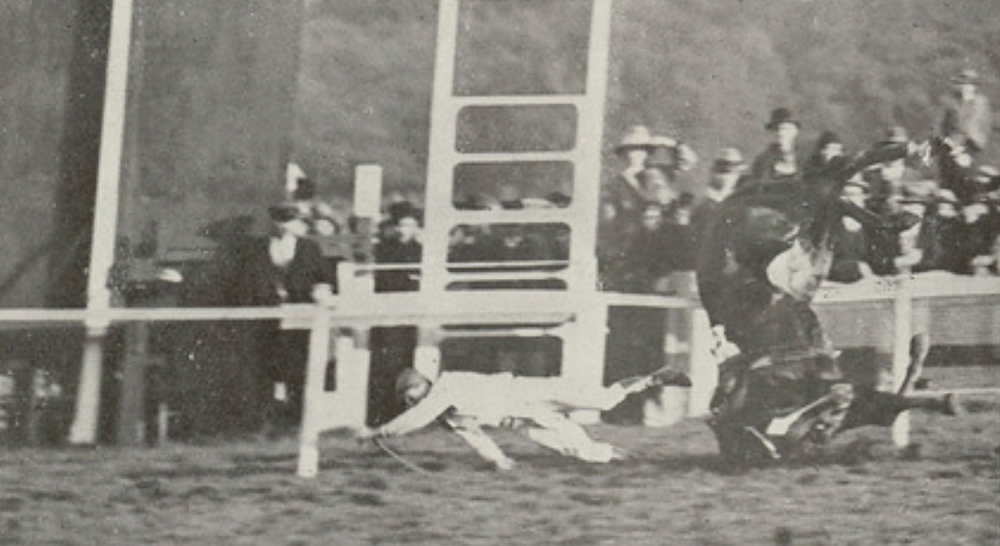
In the novel version, the horse remained lying dead on the finish line. In the real race, he got on his feet right after - in fact, just as "winning" Filidor was passing him - and readers around the country were soothed immediately after the horrendous pictures of the fall. Even more luckily, this was not the end of the horse's career. Or was it...?
Monsieur le Maréchal returned to the racetrack in January 1932, and ran three more hurdle races. He lost the Prix Masséna to Mameluck III, conceding incredible 28 pounds. Mameluck III chased home Alvarado in the Grand Prix de la Ville de Nice, a race for 500,000 francs - but Monsieur le Maréchal, carrying 73 kilograms, could not compete for the victory. Probably the final nail in the coffin came on the 8th February 1932: Monsieur le Maréchal met Mameluck III again in the Grand Steeple-Chase de Cannes, but this time, against all logic, he was asked to carry even more than in the previous race: 76 kg. The winning picture shows jockey Frigoul letting Monsieur le Maréchal calmly finish third, five lengths behind the winner. And that was it for Monsieur le Maréchal and his career.
Nothing else is known about the horse and its fate. Hopefully, it was a good one - he sure deserved it. In the novel book from my childhood, Monsieur le Maréchal was called "the king of all horses" - and judging by the real story, the nickname wasn't very far off.
Borrow (Hamburg - Forget), 1908
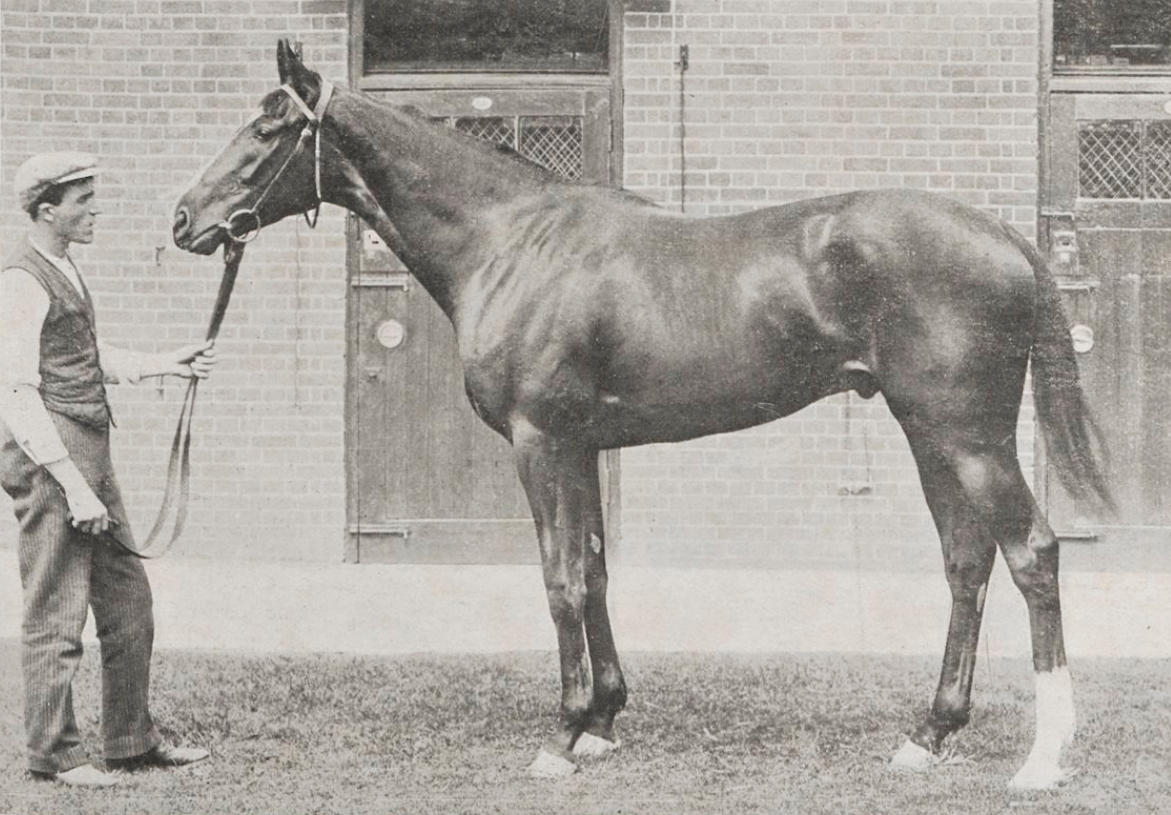
The picture of Borrow is one of the real jewels you sometimes get to find - in this case, in an old French magazine. As his sire Hamburg suggests, Borrow was an American horse, bred and owned by Harry Payne Whitney. The photo was taken in 1910, when Borrow was a two-year-old, and further examination revealed that he was a hell of a racehorse in England, winning the Middle Park Stakes - and the top English race sure had the same reputation as it does today. Even more interestingly, Borrow also dead-heated for the minor Hopeful Stakes - and the co-winner was Sunstar, the future Two Thousand Guineas and the Epsom Derby winner!
Apparently, Borrow was a horse of the great potential. However, there's no sign of him during his three-year-old season, and he returned at four and five as a mere stakes sprinter for Jack Joyner. In 1914, still owned by Whitney, he was finally brought back to the U.S. And under the care of James Rowe Sr., Borrow immediately sprung into the circles of American top handicap horses.
I won't pretend that I specialize in American early 20th century racing :) You can check his admirable record on your own - let's just count that Borrow won the Brooklyn Handicap and placed in the Suburban, Metropolitan and Carter, among many other valued handicap races. As the DRF Champions notice, the Brooklyn victory should have been Regret's - but Willie Knapp drove past the stablemate filly and let Borrow beat her by a nose.
Except for Regret, Borrow also beat The Finn, Old Rosebud, Meridian, and Flying Fairy. On a few rare occasions, mostly unnoticed by Pedigree Query, Borrow was lucky to defeat Roamer; the same goes for Omar Khayyam, who was in the stellar field of the 1917 Brooklyn. It all counts up to four Kentucky Derby winners, 7 champions with 11 division titles among them, and four American Horses of the year. Quite a score for a horse you don't hear about your entire life. :)
Speaking of which, Borrow is generally mentioned as a co-champion older male of 1914, together with a colt named Great Britain. Roamer and Old Rosebud were three at the time; The Finn was only two. As far as a European fan can tell, Borrow never got quite the same recognition as most other names I mentioned, and I suppose it's mostly a "big score" thing. Regret won the Derby, both his rival geldings Roamer and Old Rosebud were Horses of the Year; the Finn sired Zev and Flying Ebony. And Spur, who occasionally defeated Borrow, became a chain link of Plaudit's sireline after all.
So, it was really nice to find an old photograph of Borrow and search through his story. With most old pictures, you get to admire bloodlines that are no longer around - and Hamburg's blood, running back to Glencoe almost two hundred years ago, is surely one of them. But combined with a forgotten champion racehorse? What a great reward.
Carrozza's family
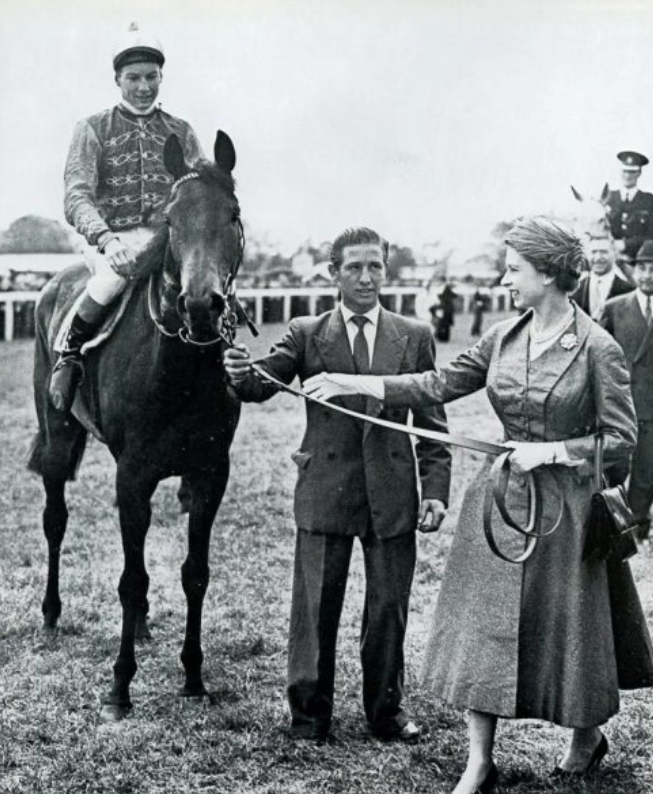
A picture of Carrozza with Lester Piggott, led by Queen Elizabeth II. after the Epsom Oaks victory, was one of the first I remember. I saw it as a kid in some ancient book, and Carrozza's name is not the one you easily forget. Sadly, you don't get to see her frequently in pedigrees.
We must admit that for a filly born in 1954, it's pretty late already - most mares in the fifth generation are about one to three decades younger. But more importantly, Carrozza was a dam of stallions - a thing fans outside of Europe or the U.S. may have not noticed.
Her first son, Battle-Waggon by Never Say Die, was sent to New Zealand. His son Battle Heights won the 1974 W.S. Cox Plate among many victories; Battle Sign won the AJC Derby in 1975, and Brava Jeannie the 1979 MRC 1,000 Guineas & VRC Oaks Stakes. Battle-Waggon became a damsire of Zephyr Zip, the third sire of Stagecraft, and overall is present in pedigrees of tens of local Gr.1 horses.
Semenenko, the last son of Carrozza, was born in 1973 by Vaguely Noble. A minor stakes winner like his brother, Semenenko did equally good in Chile, where he became the 1987 leading sire. He sired champion fillies Maria Fumata and Guardiola, as well as several Gr.1-winning colts, but his progeny also did great in the U.S. Especially Miss Brio, the Chilean Guineas winner who arrived to defeat 5 Gr.1 winners, two of them champions... :) Bayakoa lost the Gr.2 Santa Maria Handicap to Miss Brio, and Winning Colors finished fourth in Miss Brio's Maskette Stakes Gr.1 triumph.
Another Guineas winner, Quilma, followed her footsteps and conquered a pair of Gr.2 races in 1993, the Fleur de Lis Handicap and the Louisville BC Handicap. And let's mention also Bisbalense, who handed one of the rare defeats to amazing Lonesome Glory in the New York Turf Writers' Cup.
Carrozza was also a dam of minor Australian sire Call Report, and granddam of Bonne Noel, Prince Rupert, and most of all, Matahawk. The 1975 Grand Prix de Paris victor and member of the disappearing historic sireline of Son-In-Law, Matahawk sired another Grand Prix de Paris winner in Valiant Heart, and the Prix du Cadran winner Neustrien. Matahawk, Battle-Waggon, and Semenenko can be traced in pedigrees of major winners up to these days.
But where's some place for fillies among all these stallions? Carrozza's family is very rare and scattered, existing in two barely branches. The older Crepe de Chine branch was recently present in France with foals of Arakawa and had a 2023 stakes-placed filly Celisia in Japan. Still tiny but more famous branch of the Coronation Stakes-placed Tender Camilla made it to Australia, United States, and even South Africa, producing the Australian champion Helenus in the process.
American descendants of Tender Camilla include progeny of her Gr.3-winning daughter Noble Damsel, and the good news is, this particular branch seems to be doing really well. Generally being alive, producing winners, millionaires like Noble Bird and Marley's Freedom... or recent Gr.2-winning sprinter Happy Jack.
Marley's Freedom's firstborn filly was named Hope Road, and a month ago, she earned a status of Gr.2-placed when second to brilliant Kopion in the Santa Monica Stakes. Quite an aptly named filly for her family, isn't she?
Both Ends Burning
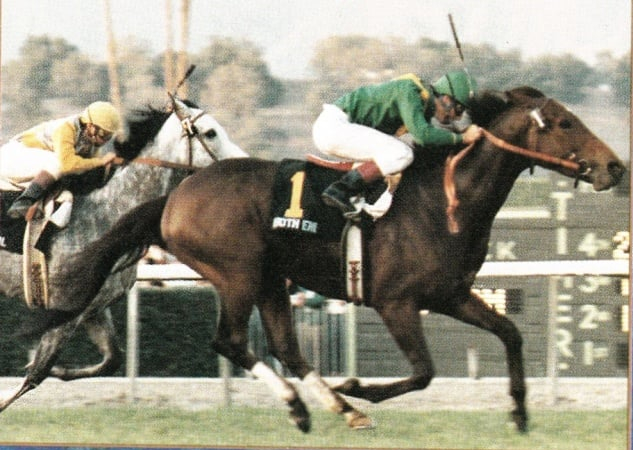
I just love pedigree research. No matter how many years you devoted to it, new names keep coming. You consider it natural with South American countries or Japan... But it happens even in the good old U.S. of A. Like with Both Ends Burning.
The 1980 gelding is distantly related to recent Gr.1-winning sisters Surge Capacity and Ways And Means. He was by Nalee's Man, a royally bred minor stakes winner, and easily became his leading earner with an admirable $912,851. Trained by Neil Drysdale, Both Ends Burning needed 10 scores and 13 place-show efforts from 35 starts, including Gr.1 efforts in each of the 1984 - 1986 seasons.
It's difficult to tell which one was the best. In 1984, Both Ends Burning dead-heated for third in the Hollywood Turf Cup Invitational behind Alphabatim, and won the Oak Tree Invitational over Gato Del Sol. He somewhat switched scores the next year, losing the Oak Tree to Yashgan and winning the Hollywood Turf Cup over Dahar, the great son of Dahlia. Worth noticing that in both winning races, he ran 12 furlongs in superfast 2:25 and change.
Both Ends Burning also ran second to Dahar in the Century Handicap, third in the 1986 edition of Hollywood Turf Invitational behind Flying Pigeon, and won two editions of the Tanforan Handicap Gr.3.
Each time you see a multiple Gr.1 winner you never heard about before, you wonder, how it's even possible. But discoveries like this keep me keenly attached to the sport. :)
Betty Beall family
As of mid-February 2025, I'm a bit late with the U.S. analyses, just having finished the 2023 season. However, it brought one of the nicest findings in a long time: the family of Betty Beall.
Her dam Macaroon (Marco) was imported into the U.S. in 1915, and left two influential daughters. Black Betty would become the fourth dam of Kelso, and her family would produce stallions like Bronze Babu, Native Prospector, Bel Bolide, or Siyah Kalem. Betty Beall would beat her anytime, though: she produced the Matron Stakes winner and the champion two-year-old filly Baba Kenny, who in turn produced the Hopeful Stakes female winner Bee Mac - a dam of the great runner and stallion Better Self. But this is not exactly the family we will be talking about today:
Baba Kenny's three-quarters-sister Beanie M. became a granddam of the Jerome Handicap winner High Tribute. And it was his full sister Silver Service who continued the family with several distinguishable names - like Very Subtle's sire Hoist the Silver, a solid Graded filly of the late 1990s Roza Robata, or Ishino Sunday, one of Sunday Silence's early classic winners.
You can see that the family is not extremely rare - but not very common either. So it was very nice to find it in the pedigree of the 2023 La Brea S. Gr.1 winner Daddysruby.